Use retinol without irritation: If you’re wondering how to use retinol for the first time without irritation, apply a pea-sized amount of a low concentration formula (0.01–0.03%) in the evening to dry skin. Apply moisturizer, retinol and moisturizer again (sandwich method) once or twice a week.
The Reality of Starting Vitamin A
I can recall purchasing my first tube of Vitamin A. I washed my face, applied the cream to my soaking wet face, and came out looking like a sunburned tomato. I had been stung for a week. I tossed the tube in the garbage.
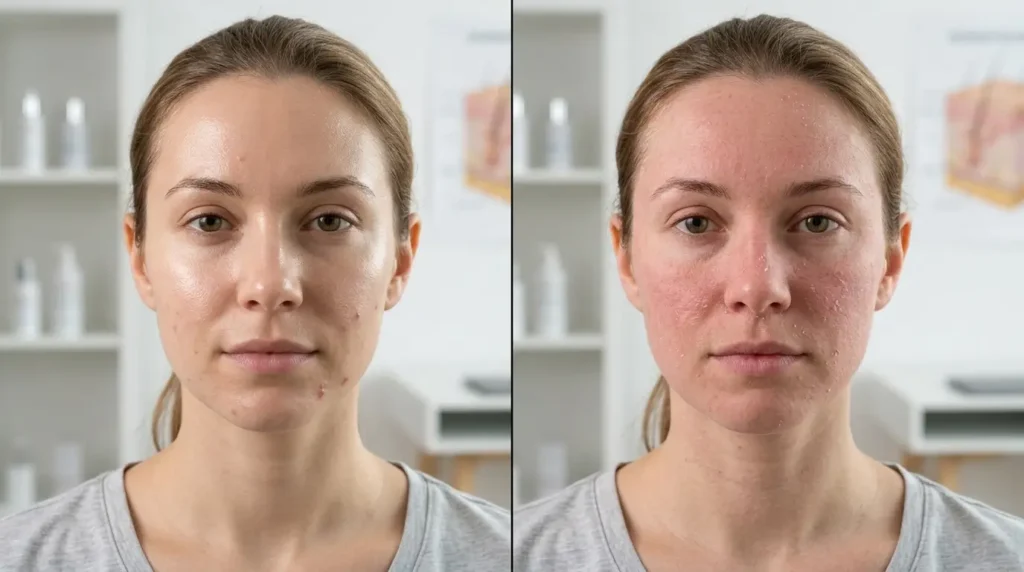
Many have experienced this very initiation. It’s what we call the retinol uglies. The product label promised you glowing skin, and you are suffering because of the intense redness, flaking and breakouts.
You don’t have to suffer chemical burns just to achieve results.
When beginning a retinol regimen, there must be a plan. You are handling a powerful chemical that changes the actions of your cells. Knowing the biology of the reaction, you can skip the peeling step.

Understanding Retinization and Your Skin Barrier
When you use this ingredient, your skin will go into what is known as retinization. It’s a transition period.
Also Read: At What Age Should You Start Using Anti Aging Products 2026
Your skin is covered by an outer layer of skin called the stratum corneum. This serves as a water-proof barrier. Retinol is a substance that stimulates the renewal of cells. It makes your skin exfoliate on the surface and thicken and strengthen on the inside.
This is a shedding process that produces transepidermal water loss (TEWL) problem. Your broken shield lets water out. Your skin dehydrates.
In the absence of water in the skin, it cannot protect the active ingredient. This is what gives rise to the burning sensation. The purpose of a beginner’s routine is to reduce the amount of shedding and keep the moisture barrier in place.
The Dry Face Rule
Water is enemy to the application of active ingredients in the skin care regime.
There is damp skin that has the property of a sponge. It absorbs topicals into your pores in no time. While this is good for plain HA, it obviously doesn’t work for Vitamin A.
Retinol will cause a severe response when applied on a wet face. Must wait 5 minutes after towel drying your face. Before you do anything else, your skin should be taut and dry.
The Sandwich Method Explained
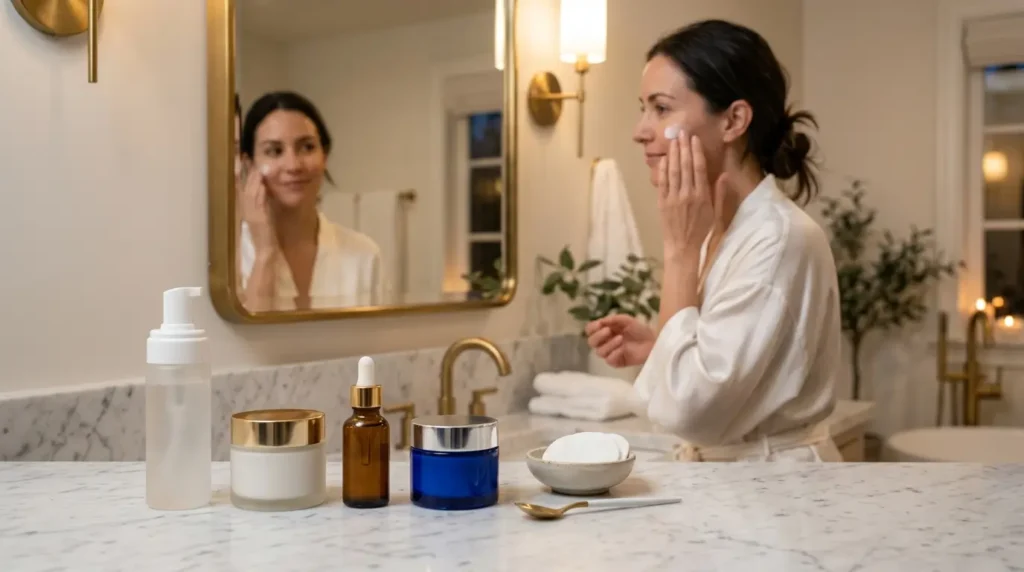
The sandwich method is used by derms and clinical aestheticians to welcome new patients. This helps to prevent direct exposure to active ingredient. It forms a physical barrier and slows down the absorption rate.
To keep your face safe, go through this same evening routine.
1. Wash Your Face
Apply a simple, non-foaming soap. Avoid acid scrubs. Use a clean towel to pat face dry.
2. Wait
Set the timer for 5 minutes. Allow any excess moisture to dry.
3. Apply the Base Layer
Apply a thin coat of an ordinary ceramide moisturizer to your face. Wait 2 minutes to absorb it.
4. Measure the Active
Squeeze out one pea-sized amount of retinol. A pea-sized drop covers your entire face. Tap small dots on the forehead, cheeks and chin. Rub it in. Try not to put it in your eyelids or corners of your lips.
5. Apply the Top Layer
Finish with a thicker night cream. This results in moisture being trapped, and weakens the strength of the underlying active layer.
Choosing Your Starting Strength
Don’t purchase the highest level product on the shelf. It is the percentage which is of greater importance than the brand name.
You want the product to be labelled with a percentage of 0.01% – 0.03%.
Also check the box for the word “encapsulated.” Retinol is packaged in a tiny fatty envelope. The shell will break down after several hours when rubbed in the face. This slow release action prevents a chemical shock to your skin.
At the pharmacy, you can find a good beginner option for $15 to $35. The brands in the clinic are $60 to $80. You’re not paying for a stronger herbicide, you’re paying for a more chic mode of delivery.
Also Read: What Is Hyaluronic Acid And How Does It Work 2026

Ingredient Compatibility Guide
Combining ingredients will break down your skin barrier. Use Vitamin A when it is a boring routine night!
| Safe to Mix | Do Not Mix |
|---|---|
| Niacinamide | AHA/BHA Acids |
| Hyaluronic Acid | Benzoyl Peroxide |
| Ceramides | Vitamin C |
| Squalane Oil | Physical Scrubs |
Niacinamide is a good pairing as it reduces inflammation. Ceramides restore the lipid shield.
Use Vitamin C only in the morning. The combination of acids and retinol in the same skincare routine causes extreme chemical irritation.
Climate Impact on Your Routine
The way that your skin reacts with this process depends on your geographical area.
In dry winter climates such as Denver or Chicago, skin barrier problems are already a challenge. Cold air dries the air out. Heavy squalane or shea butter creams are necessary for the layers of your sandwiches in these areas.
The air keeps your skin hydrated if you live in humid areas, such as Miami or Bangkok. Heavy cream will constrict your pores. Instead, use a lightweight gel moisturizer based on water for your layers of the sandwich.
Pay attention to the seasons. What works in July could be very jarring in January.

The Professional Step-Up Program
Aestheticians don’t allow their clients to apply this to their face each night. They have a step up program over three months to develop tolerance.
- Month one: Use the product 1 night once a week.
- Month two: Use the product 2 nights per week.
- Month three: Use the product three times a week.
Reside at three nights a week. This is the frequency with which you’ll reap all the anti-aging and collagen-building rewards. Its use nightly becomes more and more insignificant and can lead to chronic dryness.
Purging vs Irritation
The difference between normal skin purging and damaged barrier is imperative to know.
The increased cell turnover rate exfoliates any trapped oil and dead skin on the surface. This results in a breakout called a purge. Purging occurs in the parts of the skin where pimples usually appear. It is short-lived and lasts for a couple of weeks.
Also Read: Niacinamide Benefits For Skin Beginners Should Know 2026
Irritation feels different. Irritation feels hot. Your skin is tight and red. If you apply a light daily moisturizer and your face still burns, then you are harming your barrier. Stop using all active ingredients. Drink only water and healing ointment for 2 weeks.
Neck and Eye Area Warnings
The skin around your eyes and on your neck is very thin. Does not have the oil glands on the cheeks and forehead.
Avoid using a regular face formula under your eyes. It will make severe peeling. Purchase a separate eye cream that has a smaller percentage of the ingredient.
Take care if you want to treat photoaging on your neck. Pour in a small amount of facial retinol into a large blob of neck cream. Apply it only once a week.
Knowing When to See a Professional
OTC products have a limit on their strength. Prescription is required for use of pure retinoic acid (tretinoin) in the U.S. and Canada.
After 1 year trying to build tolerance to the drugstore stuff and not getting results, it’s time to upgrade. Find a board certified dermatologist in your area. They will be able to assess your skin and recommend a compound that is appropriate for your tolerance.
People Also Ask
Do You Put Moisturizer on Before or After Retinol?
For beginners, you do both. A light lotion is used prior to the active ingredient to buffer it and a heavy cream afterwards to seal it in. This is the sandwich method!
What Happens If a Large Amount of Retinol Is Used in the First Use?
The skin will become intensely red, flaky and feel hot. Your moisture barrier will fail and even normal water will cause sensitivity on your face.
Is It Okay to Apply Vitamin C in the Morning and Retinol at Night?
Yes. The best use of both ingredients. Vitamin C fights off free radicals to protect your skin when you’re out in the sun. At night, retinol works to heal your skin. Do not use concurrently.
How Many Days a Week Should a Beginner Use Retinol?
Begin by using one night a week. Remain there for a complete 30 days! If no redness occurs move to two nights a week.
If My Face Is Peeling, Should I Discontinue Use?
Yes. The skin does not catch up with the shedding of cells and therefore the skin becomes flaky. Discontinue product use for one week. Drink plenty of fluids. When the flaking stops, reintroduce the active ingredient at a lower frequency.
May I Not Have to Apply Sunscreen During the Day If I Only Apply It at Night?
No. The ingredient eats away the superficial layer of dead cells. Without this SPF 30 in the morning you will get extreme photoaging and sunspots.
If My Skin Just Can’t Take It, What Are the Options?
Yes. Bakuchiol is a natural alternative to Vitamin A. Does not redden or peel. It’s a wonderful choice for individuals who have sensitive skin.

Final Thoughts on Your New Routine
It will take patience to build tolerance. Your skin must get used to a new biological rhythm.
Purchase a low strength product for a low price. Dry face thoroughly. Apply the sandwich approach. Consider your moisture barrier as a delicate barrier.
By proceeding along the sequence and not trying to speed it up, you will bypass the peeling process. No painful downtime, just the smooth texture, faded lines and clear pores. Go slow and allow chemistry to take place.